> ## Documentation Index
> Fetch the complete documentation index at: https://docs.trybloom.ai/llms.txt
> Use this file to discover all available pages before exploring further.
# Build an on-brand campaign email
> Use Bloom's brand guidance and assets to create a responsive HTML email you can adapt in your email platform.
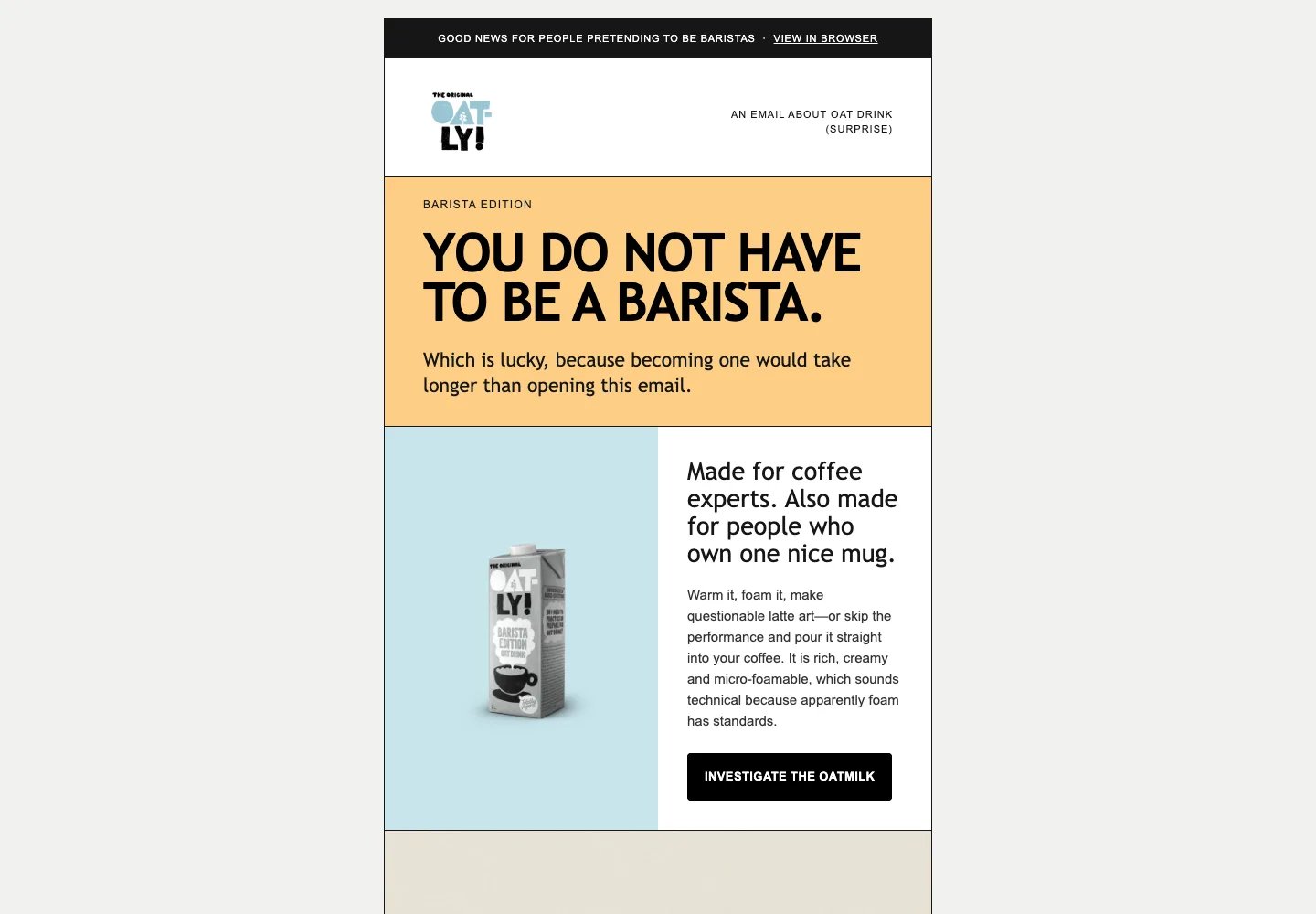 Inspect the complete Oatly concept in your browser.
Get the email source to inspect and adapt.
Bloom supplied Oatly's brand guidance and relevant files. Its conversational, self-aware voice shaped “You do not have to be a barista,” while the warm palette, black outlines, and typography guidance shaped the layout and hierarchy. Email-safe fonts carry that hierarchy across clients. The email uses the original logo and product imagery, with copy grounded in Barista Edition's verified uses.
The result is a responsive HTML email you can import into a platform that accepts custom HTML. No email-platform connection is needed to create it.
## What you need
* A development environment connected to Bloom through MCP.
* A ready brand in Bloom, or sources to [create one](/guides/create-brand).
* A campaign goal, audience, and destination for the main call to action.
## Run it with your agent
Connect Bloom through MCP in your development environment.
Adapt this starting prompt:
```text theme={null}
Build a campaign email for [brand website or existing brand], promoting
[product or campaign] to [audience], with [primary action and destination].
Use Bloom for the brand context.
Reuse a matching ready brand, or create one from the supplied sources and
wait until ready. Read the relevant brand guidance and files for this email.
Inspect and use the supplied logos and images, and apply the typography
guidance with email-safe fonts.
Create a responsive HTML email with a 600px layout, email-compatible tables,
inline critical styles, a preheader, accessible text, and font fallbacks.
Apply the brand's voice and visual guidance. Use only supported product
claims. Leave explicit placeholders for sender details and subscription links.
Preview desktop and mobile layouts, review against the brand guidance, and fix
issues. Return the HTML and a browser preview, noting what still needs testing
in email clients. Do not send or publish anything externally.
```
## How it worked
Bloom supplied Oatly's voice, palette, and typography
guidance. The selected assets included the exact logo, Barista Edition
carton, and iced-coffee image.
Barista Edition works for coffee professionals and home baristas. The email
turns that into an invitation to foam it or pour it directly into coffee,
with links to Oatly's official product page.
A table-based layout and inline styles carry the design. Columns stack on
mobile, images have alternative text, and email-safe fonts support
compatibility across clients.
Desktop and mobile browser renders were reviewed, and automated
accessibility checks found no violations. These checks do not establish how
every inbox will render the email; test it in your target email clients
before sending.
## What each system did
* Bloom supplied the brand guidance and assets.
* The connected development environment wrote the copy and HTML, then rendered and reviewed the preview.
* Your email platform handles contacts, sender identity, subscription links, and sending after you import the HTML.
## Before you send
* Replace the browser-view, preferences, unsubscribe, and company-address placeholders with your platform's supported values. Check the campaign claims and destination links.
* Send test emails through your platform and check the clients your audience uses, including mobile layout, blocked images, and fallback fonts.
This email is independent concept work, not official or endorsed by Oatly.
This documentation is built and hosted on [Mintlify](https://mintlify.com), a developer documentation platform.
Inspect the complete Oatly concept in your browser.
Get the email source to inspect and adapt.
Bloom supplied Oatly's brand guidance and relevant files. Its conversational, self-aware voice shaped “You do not have to be a barista,” while the warm palette, black outlines, and typography guidance shaped the layout and hierarchy. Email-safe fonts carry that hierarchy across clients. The email uses the original logo and product imagery, with copy grounded in Barista Edition's verified uses.
The result is a responsive HTML email you can import into a platform that accepts custom HTML. No email-platform connection is needed to create it.
## What you need
* A development environment connected to Bloom through MCP.
* A ready brand in Bloom, or sources to [create one](/guides/create-brand).
* A campaign goal, audience, and destination for the main call to action.
## Run it with your agent
Connect Bloom through MCP in your development environment.
Adapt this starting prompt:
```text theme={null}
Build a campaign email for [brand website or existing brand], promoting
[product or campaign] to [audience], with [primary action and destination].
Use Bloom for the brand context.
Reuse a matching ready brand, or create one from the supplied sources and
wait until ready. Read the relevant brand guidance and files for this email.
Inspect and use the supplied logos and images, and apply the typography
guidance with email-safe fonts.
Create a responsive HTML email with a 600px layout, email-compatible tables,
inline critical styles, a preheader, accessible text, and font fallbacks.
Apply the brand's voice and visual guidance. Use only supported product
claims. Leave explicit placeholders for sender details and subscription links.
Preview desktop and mobile layouts, review against the brand guidance, and fix
issues. Return the HTML and a browser preview, noting what still needs testing
in email clients. Do not send or publish anything externally.
```
## How it worked
Bloom supplied Oatly's voice, palette, and typography
guidance. The selected assets included the exact logo, Barista Edition
carton, and iced-coffee image.
Barista Edition works for coffee professionals and home baristas. The email
turns that into an invitation to foam it or pour it directly into coffee,
with links to Oatly's official product page.
A table-based layout and inline styles carry the design. Columns stack on
mobile, images have alternative text, and email-safe fonts support
compatibility across clients.
Desktop and mobile browser renders were reviewed, and automated
accessibility checks found no violations. These checks do not establish how
every inbox will render the email; test it in your target email clients
before sending.
## What each system did
* Bloom supplied the brand guidance and assets.
* The connected development environment wrote the copy and HTML, then rendered and reviewed the preview.
* Your email platform handles contacts, sender identity, subscription links, and sending after you import the HTML.
## Before you send
* Replace the browser-view, preferences, unsubscribe, and company-address placeholders with your platform's supported values. Check the campaign claims and destination links.
* Send test emails through your platform and check the clients your audience uses, including mobile layout, blocked images, and fallback fonts.
This email is independent concept work, not official or endorsed by Oatly.
This documentation is built and hosted on [Mintlify](https://mintlify.com), a developer documentation platform.